In my last article, I described a colleague who knew no more than the documents, but had understood them. That is the kind of knowledge I want to build. The problem is that new information never stops coming. Throughout my career, two floods have kept my mind busy: new business context and new technology.
Acquiring new business context
My CV might look odd to many people: it is a journey across all kinds of companies and industries, from small specialists to global players. After leaving consulting, my first in-house job was as an ABAP developer at a home shopping TV channel near Munich. Many people smile at that business model, but the professionalism behind it impressed me: smooth, scalable sales and service processes were everything. Next came a traditional publishing house in the heart of Munich, where a business philosophy grown over more than 250 years met an IT department eager to modernize. Then I entered the DAX world at BMW Group and the S/4HANA domain: new people, new processes, new mindset. During the Covid years, I moved on to BSH, Siemens and Airbus Defence and Space, before relocating to Denmark to join the LEGO Group as an engineer. From cars to fridges, from fighter jets to plastic bricks. Today, I work for DLG Group, one of Europe’s largest agricultural cooperatives.
Every move meant a new business context and the same question to answer: how does this company actually make money?
Acquiring new technology knowledge
The second flood started even earlier. My first job after university was at a small, specialized consulting company near Munich. It was my first real contact with the SAP world, and as a junior I had to master two things: customizing SAP CRM and extending it with ABAP. In my first days, a senior colleague dropped a copy of “ABAP Objects” on my desk: a comprehensive guide to SAP’s proprietary programming language, as thick as two bricks and just as intimidating. What followed was learning by doing, with plenty of failure, frustration and the feeling of being overwhelmed.
Back then, the SAP world was still manageable. Most of us worked on large on-premise monoliths: SAP ECC, the successor of R/3, a handful of Business Suite solutions like CRM, SRM and SCM, SAP BW for analytics and SAP XI as the integration backbone.
In the roughly 15 years since, SAP’s portfolio has exploded. Cloud applications arrived, the Business Technology Platform (BTP) became the foundation for cloud development and extensibility, and a wave of acquisitions brought best-of-breed solutions into the ecosystem. Now the story continues into AI: BTP has become a core part of the new SAP Business AI Platform, built around generative and agentic AI. And the journey is far from over.
That is just SAP. Beyond it, new integration patterns, new data platforms and an endless stream of AI models, frameworks and tools all compete for my attention.
The crucial question is: what is relevant, and what can I skip? Which skills matter for my professional future, and which are rabbit holes that eat my time without practical value? It feels like an all-you-can-eat buffet so long that I can’t even see its end.
I realized I needed a strategy.
Orientation instead of completeness
Focus was the obvious answer, but it has never come easily to me. I’m curious about new technology, and I like to explore it by getting my hands dirty. Early in my career, I was far more fascinated by building websites with TYPO3 or WordPress than by digging into the dry details of ABAP. Even when a topic has nothing to do with my job, I want to understand how it works and what it might offer future projects.
That curiosity has a downside: everything is exciting, but not everything is relevant. My head fills up with fascinating side knowledge instead of the sharp skills that help me excel at my job. Up to a point, that’s fine. But when the flood of new information becomes too massive, I need a filter.
I cannot know everything, and that shouldn’t be the goal. What I needed was orientation: a way to tell what deserves my attention from what I can safely ignore, at least for now. In other words, I needed a map.
The idea of a knowledge map
I like to borrow metaphors from the real world when I develop concepts. And my situation felt a lot like that of a hiker crossing a landscape that is only partly familiar, with the horizon hidden in fog. That is how the idea of my personal knowledge map was born: a model with four zones that shows where my knowledge stands today, and a way to plan journeys into unknown territory.
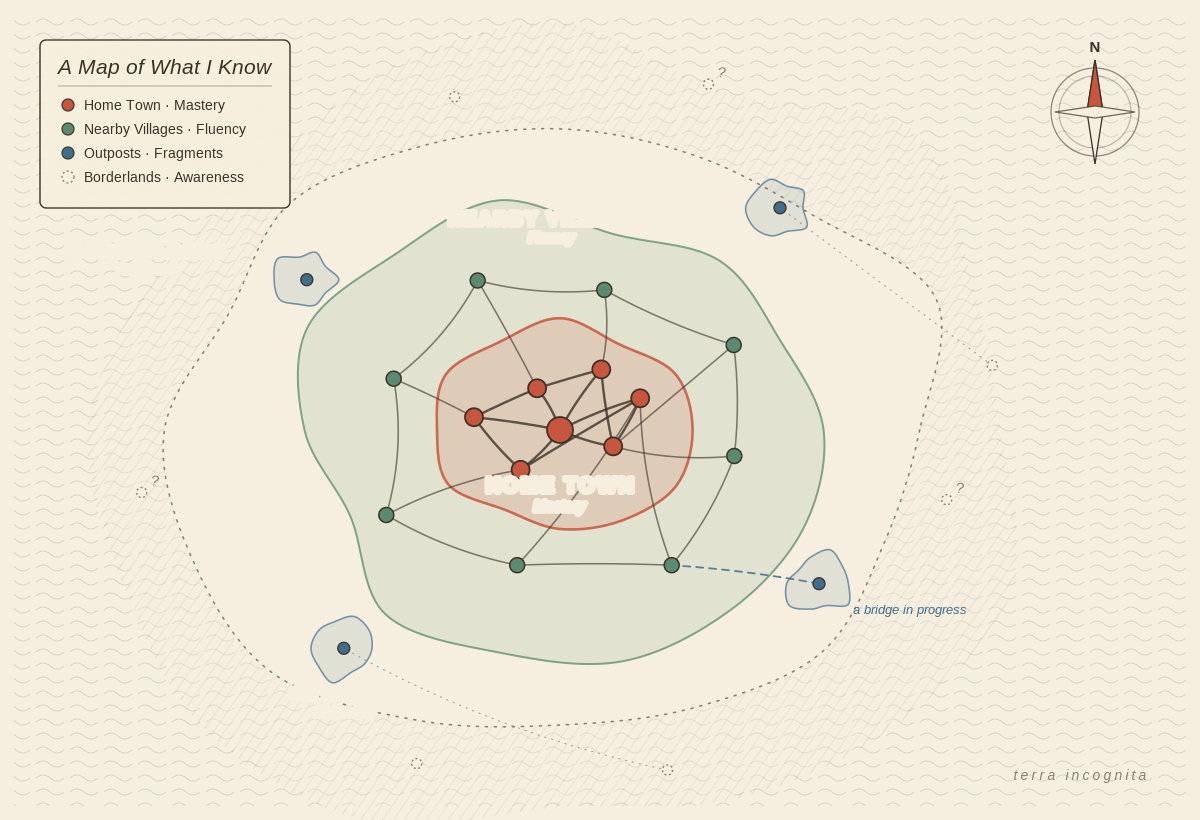
Each dot on the map is a piece of knowledge: a platform, a tool, a method. The lines between them matter just as much, because connections are what turn isolated facts into understanding. The closer to the centre, the denser the network.
The idea isn’t entirely new. Warren Buffett speaks of a “circle of competence” and stresses how important it is to know its edges. My map takes this a step further: instead of a simple inside and outside, it has four zones, connections between them, and paths that lead from one to the next.
Home Town
Home Town is the centre of my map: the zone of mastery. This is where I grew up professionally, where I know every street and every shortcut, and where I find my way even without a map. Its street map is my expert profile.
For me, this is the world of the big SAP platforms. I have worked with SAP CRM, SAP ECC and SAP S/4HANA for more than 15 years, in almost every aspect: customizing, extensibility and integration, governance and security, authorization and access management. Home Town also includes the craft around large SAP transformation projects, from project management to the soft skills it takes to bring business and IT together.
What makes this zone special is not how much I know, but how deeply I understand it. I don’t just know which transaction to call; I know why the system works the way it does. That is why this knowledge carries over when something new comes along.
Still, even a home town changes. New districts appear, old ones are rebuilt. If I stop paying attention for a few years, I will get lost in my own streets. So this is the one zone where I deliberately keep up: not with everything, but with what changes its foundations.
Nearby Villages
Around my Home Town lie the Nearby Villages: the zone of fluency. These are places I know well enough to find my way around, even if I don’t live there. Some I visit regularly, others I haven’t seen in years, but all of them are connected to Home Town by a road. That connection is what makes them villages rather than outposts.
Every time my work took me beyond the SAP core, I founded a small village. Extension programming for SAP Solution Manager was one. Setting up a project management environment in Jira and SharePoint was another. Some of these tools are niche, some are already obsolete, but they taught me concepts that still help me today.
Like real villages, they need maintenance. If I don’t visit for a long time, they slowly fall into disrepair, and in many cases that’s fine. But when I need one again, I can return, repair the old houses and make them habitable in a short time, because the foundations are still there.
I can’t maintain too many villages at once, so I have to decide which ones to keep. Take my basic web design knowledge. I built websites by hand for years, but today AI agents do most of the design and build work. This blog was created exactly that way. I don’t want to hand-write HTML and CSS anymore, so I will let this village go. Python is the opposite case. With the rise of AI, machine learning and data analytics, it is becoming more relevant every year. That village deserves investment: new roads, new houses, maybe one day a town of its own.
Outposts
Further out, beyond the villages, there are a few small outposts: the zone of fragments. I know they are there and I know roughly what they do, but no road connects them to the rest of my map. Many of the services on SAP BTP sit here for me. With proper guidance at hand, I can activate and configure them, but I don’t understand them deeply, and I don’t plan to invest more than I need.
The reason is simple: outposts are exposed. A competing vendor’s best-of-breed solution might replace a service within months, and sometimes SAP itself retires a product that was part of its portfolio only yesterday. Building a town on such unstable ground would be a waste of effort.
So I need to decide which outposts to defend and which ones to give up. What I need from each of them is just enough knowledge to act when it matters. When a decision is due, a proof of concept is often the best way to settle it, and the winning solution might well be one I know little about.
An outpost can grow into a village once a road is built. But that rarely happens because I decide it. More often, a business requirement or a new IT strategy makes a service important enough to justify the investment. Then the road is worth building.
Borderlands
Beyond the outposts lie the Borderlands: the zone of awareness. Here the fog sets in. I know some names and the rough direction they lie in, but nothing more. And beyond the Borderlands lies true terra incognita: the things I don’t even know I don’t know.
The Borderlands don’t need settlers, they need scouts. I don’t have to understand what happens out there, but I need to notice when something starts moving. This is where my curiosity, so often a distraction elsewhere, finally does its job. A short trip, a weekend experiment, an hour with a new tool: that is enough to see whether something is worth watching.
A few years ago, I would have placed everything related to AI out here. Then an army came marching out of the fog, without much warning. It did not move politely from zone to zone. It overran some outposts, made a few tools in my villages look old overnight, and soon reached the gates of Home Town, as AI found its way into SAP itself. For a while, it wasn’t clear whether it came as friend or foe. I started negotiating cautiously: I subscribed to ChatGPT, later to Claude, experimented privately and gave the newcomers a small outpost.
In 2026, it is clear that this is not enough. I need to found a village called AI Town and spend real time there. One day, it may even become a district of Home Town. That is the lesson the Borderlands taught me: most of what appears there fades away again, but now and then, something arrives that redraws the entire map. Exploring the fog can be fun, and it can end in disappointment. Ignoring it is the only option I can’t afford.
Navigating and travelling
A map is useless if you never leave home. Its purpose is twofold: to show you exactly where you stand, and to help you plan a journey to somewhere you have never been. In practice, that comes down to a few simple habits. When something new appears, I first ask where it belongs on my map. Then I decide: does it deserve investment, a quick look, or nothing at all? And from time to time, I review the whole map: which villages to maintain, which outposts to give up, and what is moving in the fog.
So far, I have only mapped my technical knowledge. But the same approach works for business context, and there it matters even more. With every job change, I set out on an expedition into unknown territory. My technical Home Town travelled with me, but my business map had to be redrawn almost from scratch: new industries, new processes, new ways of making money.
On such a journey, it pays to pack your luggage carefully. Much of what I knew remained useful. The principles of financial accounting and controlling are the same in every company, and SAP’s core processes look surprisingly similar across industries. What I packed most of all were analogies: this new company works a bit like that old one, except here.
Over time, that luggage turned into something I could not have learned in any training: judgement. Having seen many industries and companies of all sizes, I often bring a different perspective than colleagues who have spent their whole career in one place, just as they bring a depth I can only gain over time. None of this replaced my Home Town. It rebuilt it: many old buildings still stand, new ones were added.
Every map is personal, and no two look alike. But the principle holds for everyone: I quit keeping up with everything, and started understanding what matters. That is what my colleague had done all along.
Which raises a question for those who are just starting out: what if you don’t have a Home Town yet? Where do you begin? In my next article, I want to explore exactly that: how do we educate new people in IT when AI is taking over the work that junior consultants used to learn from?
A note on how this was written: the ideas, experiences and opinions in this article are my own, and so is every decision about what stays and what goes. I use AI as a sparring partner to challenge my drafts and sharpen the wording. That seems only fitting for a blog about humans and AI working together.