
A few months ago, a friend told me that his company had introduced a fancy new CRM system with a lot of AI capabilities. Creating a sales opportunity now means having a conversation with an AI agent, similar to SAP Joule. It takes 20 minutes. In the old CRM system, it took three.
Twenty minutes instead of three. Keep that number in mind – we will come back to it.
Two headlines, one question
These days, two kinds of articles fill my LinkedIn feed:
- AI will replace SAP.
- SAP is turning to AI to survive.
Taken literally, the first one is nonsense. SAP is a software vendor, not a piece of software. S/4HANA is built on hundreds of millions of lines of code and decades of legal, tax and industry requirements. That is not something you rebuild with your favorite vibe-coding agent on a gloomy Sunday afternoon.
But those who make this claim seriously usually mean something more subtle: The ERP system will shrink to a mere system of record – a database of postings and master data – while the real work moves into a layer of AI agents on top. That version deserves an answer, and I will give one at the end.
The second headline leads to the question that actually matters: Where in the very specific world of ERP – my professional home town – does AI create real, measurable value?
Not everything tastes better with ketchup
Whenever a software vendor announces “something with AI”, I think of ketchup. Believing that every software solution gets better with AI is like believing that every dish tastes better with ketchup.
The Gartner Hype Cycle has described this pattern since 1995: Disruptive innovation creates a huge gap between expectation and reality. AI may be the most disruptive technology I have seen in my career, so the hype is huge as well. And companies that earn a lot of money also tend to burn a lot of it – right now by inventing problems they can solve with AI, instead of solving real problems with the right tools.
That is why I use one yardstick only: financial business value. Every other parameter quickly becomes too fluffy to be useful.
An experiment: asking AI where AI belongs
To test my skepticism, I ran a small experiment – with the help of AI, of course.
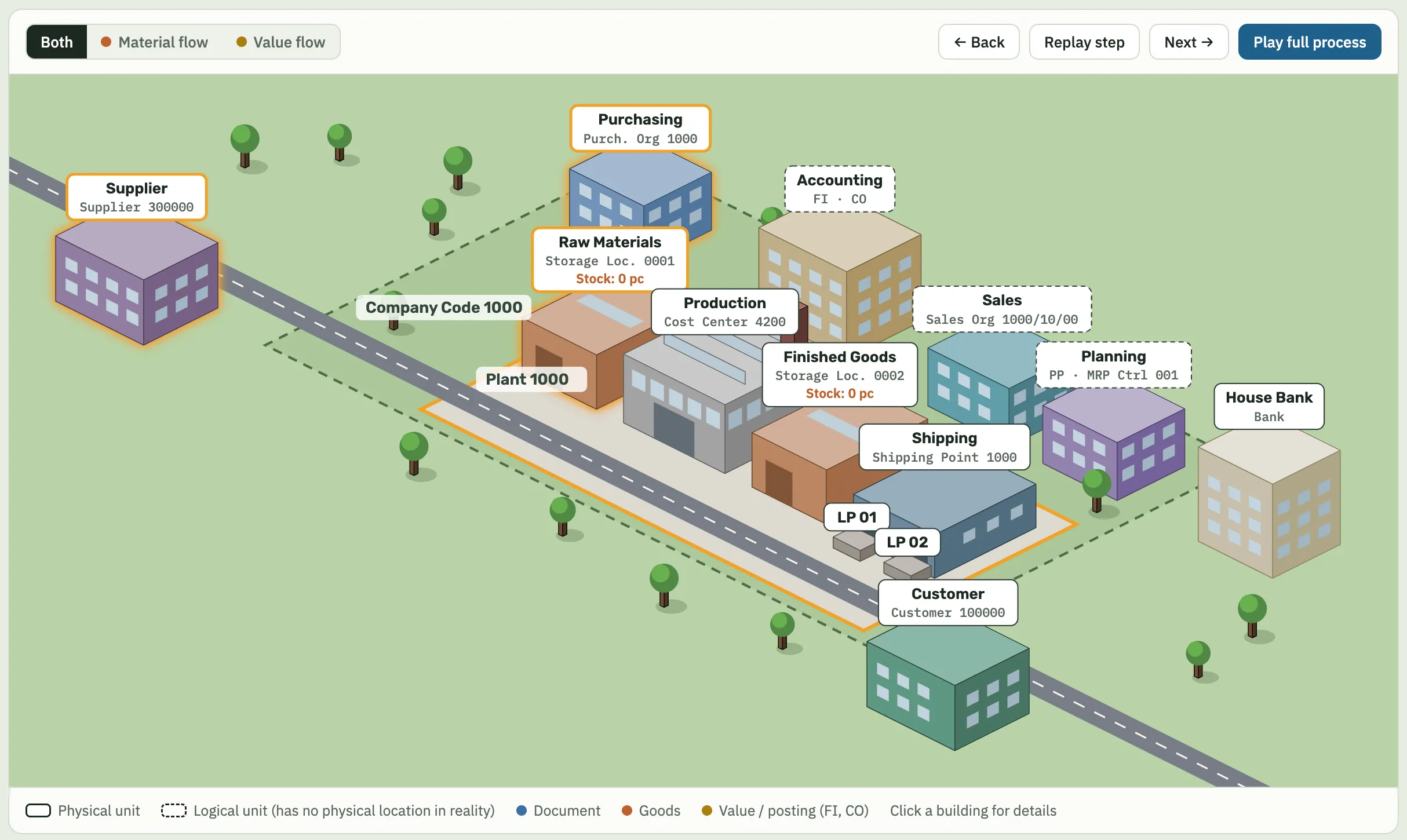
First, I asked Claude to map the core processes of SAP ECC and S/4HANA: Material is procured from a vendor and paid for, received in the warehouse, turned into products, sold and shipped to a customer. Along the way, invoices are created and paid, entries are posted and money flows.
This is the heart of every ERP system, and it is remarkably stable. When five former IBM employees founded SAP more than 50 years ago, they started from a simple observation: Every company implements the same finance processes again and again – so why not build generic, customizable software for all of them? Five decades later, an invoice is still an invoice, and a month-end closing is still a month-end closing.
This was the output of AI:
Then I asked the decisive question:
Where would you recommend placing AI agents to create business value in this flow of goods and money?
This is the updated view:
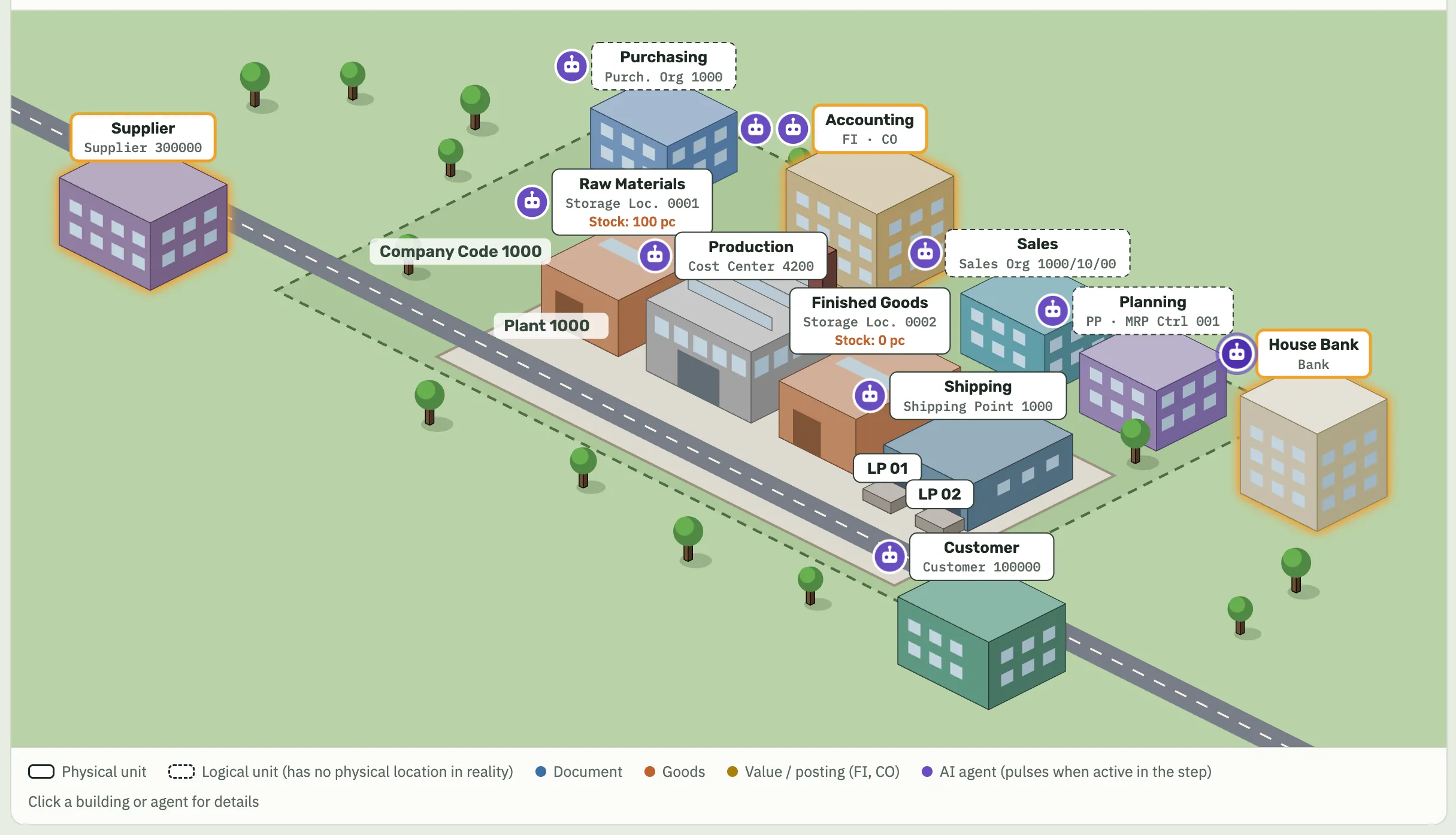
For full transparency, here is the complete answer – ten agents along the flow of goods and money:
| Agent | Area | What it does | Expected benefit |
|---|---|---|---|
| Procurement agent | Purchasing | Turns requirements from MRP into purchase proposals, compares contracts, prices and supplier reliability, and prepares the purchase order. Afterwards, it monitors order confirmations and date changes. | Shorter time from requirement to purchase order, less off-contract buying |
| Goods receipt agent | Raw materials | Reads delivery notes and labels by scan or photo, matches them to the purchase order and prepares the goods receipt posting. It reports quantity or condition discrepancies immediately. | Fewer data entry errors, stock available sooner |
| Invoice agent | Accounting | Reads incoming invoices from email, PDF or e-invoice, performs the three-way match and resolves discrepancies directly with the supplier. | More invoices posted without manual work, fewer blocked invoices, fewer missed cash discounts |
| Payment and liquidity agent | House bank | Before the payment run, it checks cash discount deadlines and liquidity, proposes the best payment date and spots suspicious changes to supplier bank details. | Higher cash discount capture, protection against payment fraud, better liquidity forecasts |
| Planning agent | Planning | Works through MRP exception messages, checks material and capacity, and proposes start dates and order sequences. | Fewer bottlenecks and rush orders, better on-time delivery |
| Shop floor agent | Production | Creates goods issues, confirmations and goods receipts from scan and machine data, and detects time and consumption variances while the order is still running. | Up-to-date actuals; variances show up immediately instead of at month-end |
| Controlling agent | Accounting | Runs settlements during period-end closing, analyzes variances on orders and cost centers, and writes clear explanations. | Faster close; every variance is explained and linked to its causes |
| Order agent | Sales | Turns customer orders from email, PDF or portal into sales orders and commits delivery dates based on stock and the production plan. | Faster order confirmation, fewer entry errors |
| Shipping agent | Shipping | Groups deliveries, plans ramps and loading times, books carriers and sends shipping notifications with tracking. | Better use of loading points, shorter truck waiting times |
| Receivables agent | Customer | Checks invoice data before sending, matches incoming payments to open items, and handles dunning and deduction disputes. | Shorter days sales outstanding (DSO), fewer unmatched payments |
Old ideas in new clothes
The answer was enlightening – because almost nothing in it was new to me. Take the payment and liquidity agent: It checks cash discount deadlines and liquidity before the payment run, proposes the best payment date and spots suspicious changes to supplier bank details.
Sounds impressive. But the SAP payment program has optimized payment dates against cash discount terms for decades. Liquidity planning and cash management have been in the portfolio just as long. And changes to supplier bank details are classically protected by dual control on sensitive vendor master fields, often backed by specialized fraud detection tools.
I found the same pattern again and again. Most of the suggestions are things I know from custom ABAP Z-code or from third-party solutions built on top of the SAP standard.
To be fair: A language model learns from what already exists, so it will naturally suggest what has been built before. But that is exactly the point. Even when we ask the AI itself, it does not find a new ERP. It finds better extensions.
When AI actually beats classic code
So when is an AI agent worth it? My working hypothesis:
- AI creates value where inputs are unstructured, where exceptions and variations are frequent, and where a human currently has to interpret and decide.
- Deterministic logic wins where a fixed rule does the job. It is cheaper, faster and auditable, and it gives the same answer every time. For an auditor, that is not a weakness – it is a requirement.
Apply this to the payment agent and it splits in two. Picking the payment date that captures the cash discount is a rule – classic code has done it reliably for decades, and an agent adds cost, not value. Spotting a fraudulent bank detail change among thousands of legitimate ones is pattern recognition under uncertainty – exactly where AI can beat a static rule. One agent, two very different business cases.
And my friend’s CRM? Creating an opportunity is structured input that a simple form handles in three minutes. Turning it into a twenty-minute conversation is ketchup on a dessert.
The core stays, the layer changes
This brings me back to the claim that AI will reduce ERP to a mere system of record. If AI agents mainly replace and improve extensions, the ERP core does not disappear. It becomes more important – as the reliable, auditable foundation that every agent depends on. The layer on top changes; the foundation stays. And the classic make-or-buy decision does not vanish just because writing software has become easier.
So, does everything taste better with ketchup? No. AI on top of enterprise software does not automatically mean higher productivity, higher revenue or lower costs. Each case has to earn its place – and every check starts with the business requirement and the financial value behind it, not with the technology. This is the shift from solution thinking to value thinking that I have argued for in my previous articles.
A note on how this was written: the ideas, experiences and opinions in this article are my own, and so is every decision about what stays and what goes. I use AI as a sparring partner to challenge my drafts and sharpen the wording. That seems only fitting for a blog about humans and AI working together.